



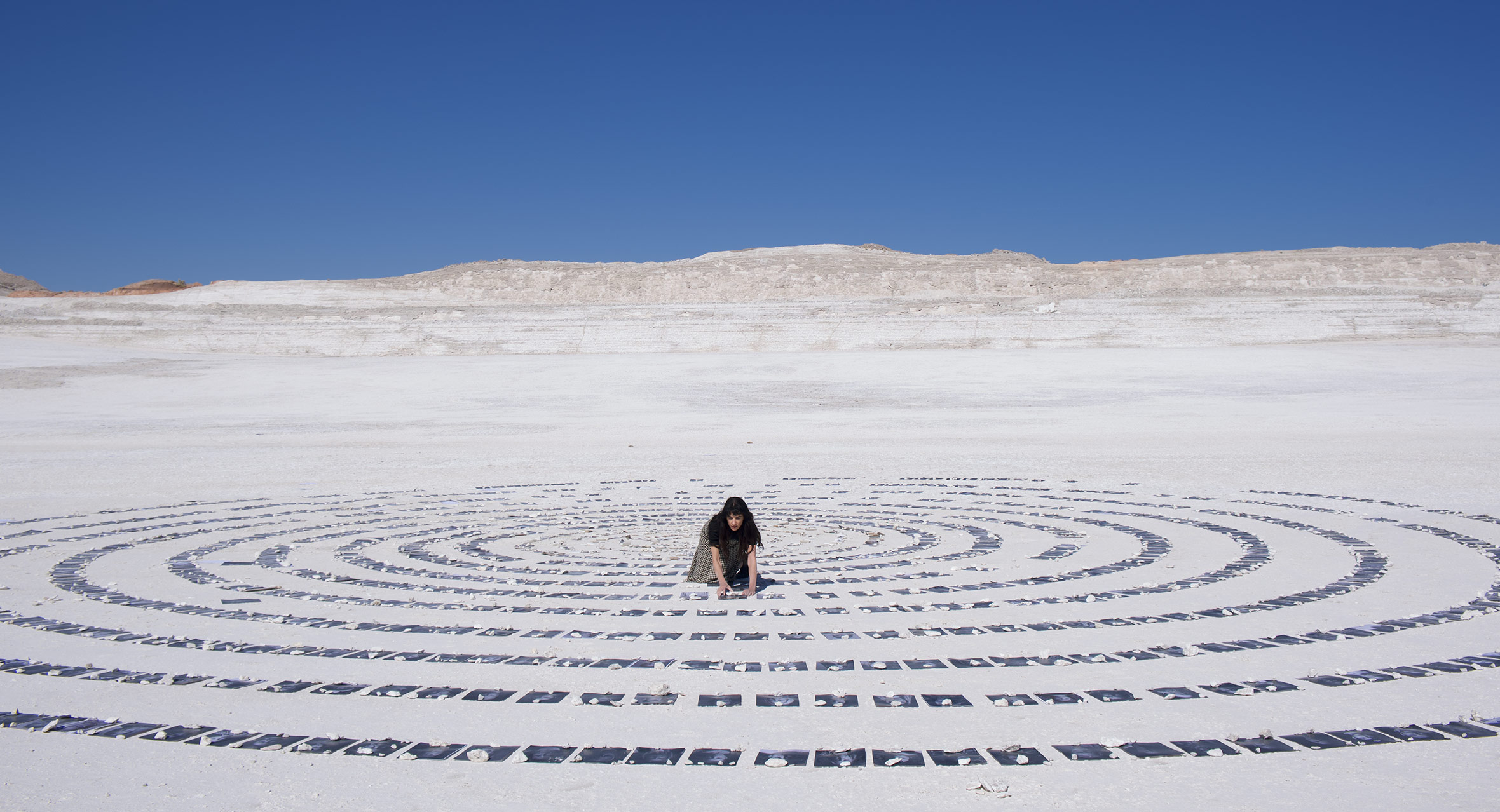
Shirin Neshat, Land of Dreams, 2019, Film Still, © Shirin Neshat, Courtesy the artist, Gladstone, & Goodman Gallery, Johannesburg, Cape Town and London
Oscillating between worlds
Shirin Neshat, the Iranian-born artist speaks to New York Times contributor and Iranian-born writer, Farah Nayeri. As featured in CATALOGUE 8.0, the magazine of Cork Street Galleries, celebrating 100 years of art on Cork Street…
Shirin Neshat has few vivid memories of her childhood in Iran. Yet one particular afternoon in the city of Qazvin, her birthplace, remains forever etched in her mind.
As she sat sipping tea with her family under the trees in the garden, the call to prayer suddenly echoed across the city. Hearing the Koranic chants ring out from a nearby mosque, young Shirin began weeping uncontrollably. In that singular moment, the two worlds she knew collided – the secular, Westernised reality of her middle-class family, and the deeply religious reality of the people in the surrounding city. It filled her with a deep sense of melancholy.
Neshat has been oscillating between those two worlds ever since: in her life, and in her art. Having moved to the U.S. aged seventeen (only a few years before the Iranian Revolution), she is now a U.S. citizen living and working in New York. Yet she frequently reexamines the contradictions and complexities of being a woman of Iran.
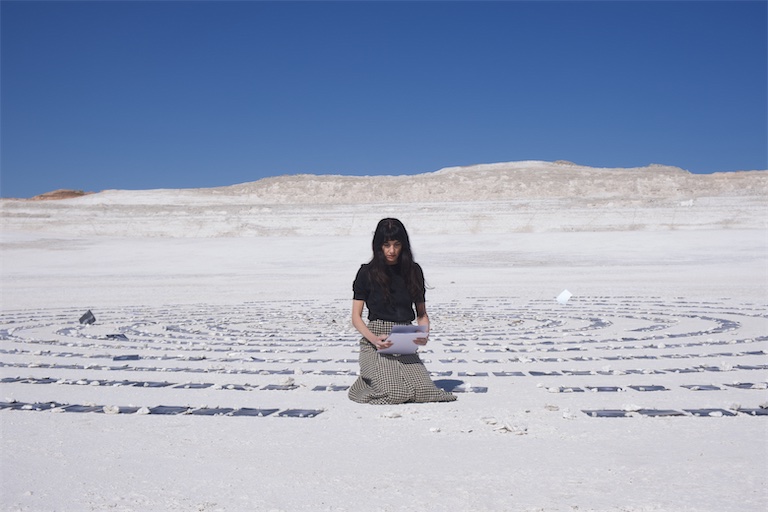
Shirin Neshat, Land of Dreams, 2019, Film Still, © Shirin Neshat, Courtesy the artist, Gladstone, & Goodman Gallery, Johannesburg, Cape Town and London
Farah Nayeri: Identity is at the heart of your work. You’re an Iranian-born artist living in New York, yet one with a deep connection to your homeland. You’re torn between East and West, between your past and your present. It sounds like that same duality existed in your childhood home.
Shirin Neshat: I lived in a house that was like an oasis: very simple, but with a beautiful garden. My father and mother were more European and progressive at home. They kept up a Westernised atmosphere inside the house. Outside, everybody was very religious and conservative and strict. My parents were different people in public. So I was caught in the duality of these two very opposing worlds: looking to the past versus looking forward, Islam versus the West.
Then came the dream of America. My father was educated. He had travelled outside Iran. He had a fascination with the West, and he wanted the same for his children. So my brothers and sisters and I grew up with this vision of America, of Utopia, this vision of perfection: a place where everything was sunny and perfect, the houses, the beautiful cars. We were watching Hollywood movies, and Hollywood embodied America.
The Iran of the 1970’s was the breeding ground for the Revolution to come. There was a lot of underground activity among people of my generation, and religious fervour against the government. Yet there was also this fascination and obsession with the West, which was happening in Tehran, but also in my house.
FN: Can you describe what it was like when you arrived in the U.S. in the mid-1970s?
SN: It was a true nightmare. What I saw was nothing like what I had imagined. I was living in an apartment building outside Los Angeles, which was nothing like Hollywood movies. I missed my family. I missed my home. I was like a fish out of water. I was begging my family to send me back to Iran. Then, soon afterwards, the Revolution happened.
In 1990, after eleven years of not seeing my family, I finally went back to Iran with my one-year-old son. I couldn’t even recognise my family, or the country.
FN: Why couldn’t you recognise your family?
SN: The last time I had been with my mother and sister, they were Westernised women wearing European fashions and hairstyles. Now they were all covered with a veil. In the city, there were anti-Israel and anti-U.S. banners and slogans. The Revolutionary Guards were everywhere. Once, they arrested my sister on the street because she had too much makeup on. It was so extreme, and I was really frightened. But there was something really fascinating about what I was seeing.
I went back to Iran a few times, with my son Cyrus, and started to reconnect with old friends who were very active during the Revolution. I started to buy books, to really learn about what happened while I was gone. I ran into an old friend who had written a philosophy paper on the concept of martyrdom in post-revolutionary Iran – really dissecting what it took for people to stand at that intersection of life and death. The idea of martyrdom was something that the government had encouraged before and during the Revolution, and that had become institutionalised. This subject really stuck with me.
I then saw a book called Female Warriors of Allah by Minou Reeves, with a cover showing a woman with a hijab holding arms. I researched the resurrection of female militancy during the Iranian Revolution. When I got back to New York, I felt I needed to do something for myself. I got a little residency and started to develop this idea of making images.
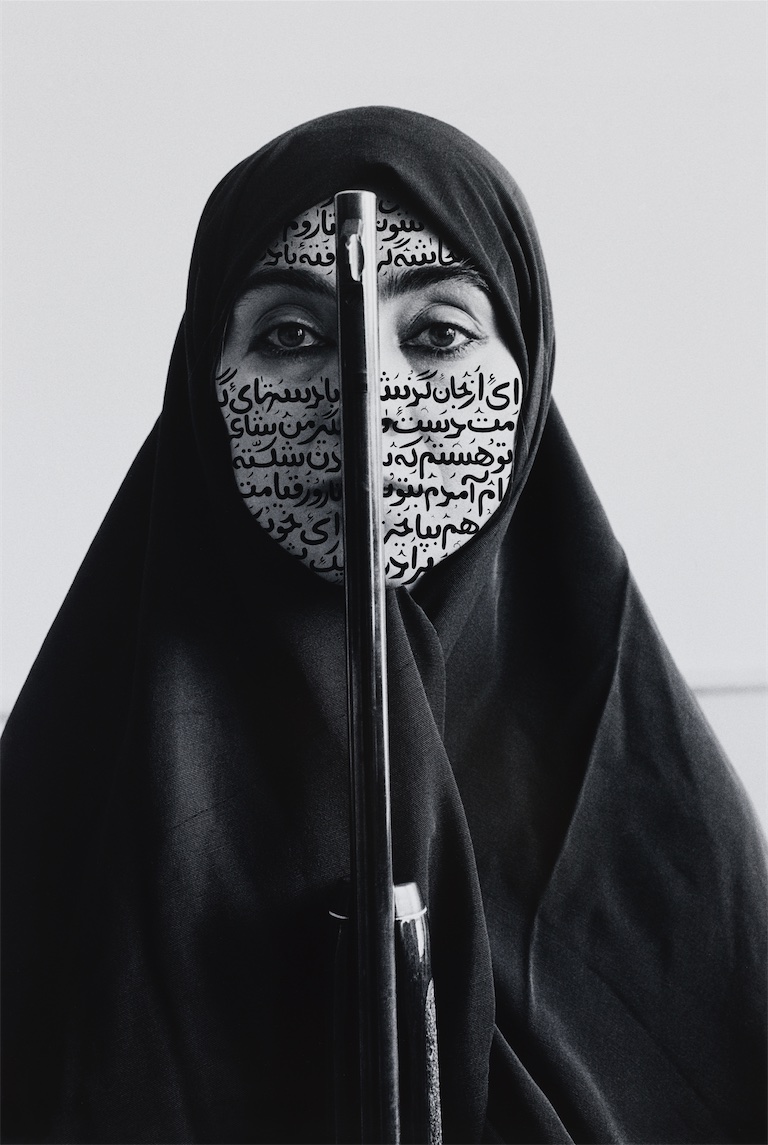
Shirin Neshat, Rebellious Silence, 1994, Gelatin silver print & ink, 118.4 × 79.1 cm / 46 5/8 × 31 1/8 ″, © Shirin Neshat, Courtesy the artist and Gladstone
FN: Can you talk about your very first gallery exhibition?
SN: A very small non-profit gallery called Franklin Furnace was looking for proposals for exhibitions. I had never made any art. I wrote a one-page proposal to make an exhibition about women of Iran, the Revolution and militants. I got accepted. That’s how I got started.
I photographed my face, my full body, my feet, my hands, and then I wrote on them, playing with inscriptions on the body. I was very inspired by how text is integrated with image in Islamic and Persian art: inscriptions of poetry or religious texts over architecture, in Persian miniatures.
FN: Why were you photographing yourself?
SN: My obsession was with the woman’s body, especially the body of the Iranian woman. And I thought, I’m available. I’m the only one I can photograph.
The woman’s body represents so many other things. It becomes a sort of contested space for political rhetoric. It’s a place of shame and guilt. It’s a place that women are meant to conceal so that men are not provoked sexually. It’s such a loaded, problematic subject. It represents desire, repression, disgust, this incredible temptation. The veil is this boundary between the inner and the outer world.
My images would not have been born if I had not read the poet Forugh Farrokhzad and her writings about the female body and challenging the traditional system. Her books were banned for a while, because she always talked back to the system. She was famous for having a married lover. She talked openly about her desire for the opposite sex. I started seeing images through her writings.
FN: You got noticed with that first gallery show.
SN: A Bronx Museum curator, Betti-Sue Hertz, saw the show and decided to include me in a group show about artists who were immigrants. That’s when I decided to make work dealing with female martyrdom, ‘The Women of Allah’.
When the Bronx Museum show opened, it blew up. Everybody noticed my work, and people started calling me. I didn’t even have a portfolio. I was included in the Venice Biennial.
FN: Why did people react in that way? Iran in the mid-1990s was shut off from the world, and people in the West imagined Iranian women as enslaved, jailed by the veil.
SN: It was the contradictions in the image: the sensual body of a typical Iranian woman wrapped in the veil, being armed, being violent and being dangerous. People found that crazy, provocative. It didn’t fit their description of the submissive, passive, victimised woman of Islam.
I was trying to understand the mindset of a woman who could stand on that threshold of love and hate and cruelty and violence. How could a woman who gives birth, who loves God and has this much sense of sacrifice be willing to commit so much cruelty?
I was never trying to impose my own view about whether this religious ideology is good or bad. I was trying to raise a question but never to provide an answer.
FN: What about people in the West who took your images literally?
SN: A lot of people thought that this represents all Iranians. I kept saying that I was talking about a minority group of women who were voluntarily armed.
What’s interesting is that, to this day, these images, which were made in 1994, are very relevant. The whole idea of fanaticism, the idea of suicide bombers, the idea of dying for your faith, ISIS, the Taliban… not only in Islam, but everywhere. The way in which fanaticism has this philosophical, moral, political way of brainwashing people is so powerful.
FN: This issue of CATALOGUE has, at its heart, the theme of courage in the face of adversity. Can you talk about the bravery involved in making art?
SN: When I look at all of the work that I’ve done, I feel that I don’t hold back, that I really don’t have a filter or calculation. I don’t worry about whether this is going to sell or not. My work is not easy to sell. It takes sometimes forever to sell. But I think that that is something that has saved me.
FN: Can you talk about your most recent work? You have been looking at America – at blue-collar communities, immigrant communities.
SN: Something happened to me about ten years ago, at around the time of Donald Trump’s first presidential term. I thought, what am I doing? I keep traveling to Morocco, Turkey, Mexico, Egypt, and I make work about Iran. Meanwhile, hell is breaking loose in the country where I live, and there’s so much to examine and say about being an immigrant.
The ‘Land of Dreams’ came from my trying to share my point of view as an Iranian-American about the U.S. ‘The Fury’ came from my asking myself: can I actually make a work in my own town? Now I am releasing a trilogy of videos.
FN: You recently said that as an artist, by getting close to other people’s pain, you cope with your own. Can you speak about that?
SN: It’s been very impactful for me, the last few years living in Bushwick, Brooklyn, which is almost 90 percent Hispanic – because it’s extremely poor, and I see a lot of struggling people. I’m surrounded by undocumented migrants who are working for pennies.
I like that contact with reality. I don’t want to be one of those artists that lives in a bubble. I don’t want to have an office that’s like a corporation, or be in a studio where I have a manager. I don’t want to be a person who avoids protests or voicing her opinion about political situations because she’s worried about collectors not buying her work. I don’t want to be an activist, but I don’t want to be filtered either.
As an artist, there is this bigger world that you are a part of. Art is the thread connecting the two realms.
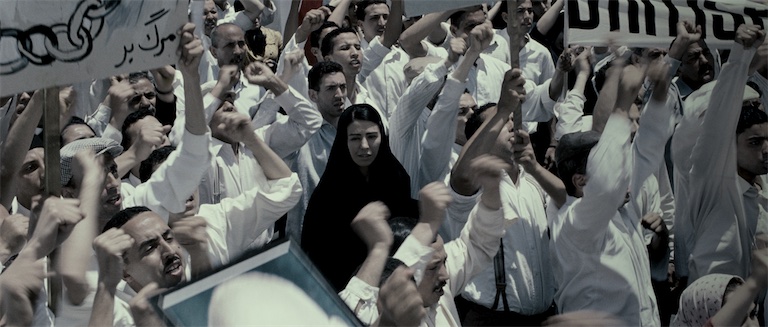
Shirin Neshat, Women Without Men, 2009 , © Shirin Neshat, Film Still, Courtesy the artist and Gladstone
FN: You’re also a filmmaker: You won the Silver Lion at the 2009 Venice Film Festival for your movie Women Without Men. Can you speak about cinema?
SN: You talked about bravery. I don’t think I’m very brave, but in the case of entering the film world, I was very brave. The minute I felt like I was repeating myself in the art world, and just making one video after another, one photograph after another, I took a six-year hiatus, and turned this complicated book Women Without Men into a movie.
It was the most challenging but also the most gratifying experience of my life, and I will never regret it. The film is not perfect, but I’m glad I did it, and it also gave me a sense of confidence and independence from the art world: the sense that I can make a film that actually wins at a major festival.
FN: You describe your work as melancholy, and that is a feeling that also runs through Persian art, music and culture as a whole.
SN: There’s so much to be sad about. We’ve had a very dark history in Iran. Look at how many millions of people are separated, divided, fighting – war, executions… It’s been a terrible modern history.
I haven’t seen or been in my country for years. I will never see my mother again. The melancholy comes from this sense of loss: the disconnect. We keep repressing those emotions, because we have to live in the present, because it’s unbearable emotion and melancholy. Then comes a piece of music, a line of poetry, a movie or an artwork, and all of those emotions resurface. They bring you back to what you haven’t wanted to face.
FN: How do you view your career as an artist, looking back on it today?
SN: I’ve been very lucky, because there are people who supported my work in major museums all over the world, collected my videos. As an Iranian woman in a male-dominated Western culture, I think I did pretty well. I have a decent name, and I do sell enough to live and support my team. So I’m happy. As long as I have money to make new work and pay my bills, I have done fine.
Shirin Neshat is represented by Goodman Gallery, 26 Cork St.