



William Kentridge: 'A Nicely Built City'
William Kentridge shares a West African proverb: “a nicely built city never resists destruction.” The artist has history navigating the phrase, which titles an etching from 1995. These powerful words loom with continued fascination.
Now Goodman Gallery London leads with the global premiere of the South African artist and theatre director’s new stop-animation: A Nicely Built City (Never Resists Destruction). This twelfth film in his globally acclaimed cycle of Drawings for Projection (1989–ongoing) was developed and produced over nine months in the artist’s Johannesburg studio. The film forms part of a wide-ranging presentation of new drawings, sculptures and editioned works on paper linked to two major projects, shown together on Cork Street under the title ‘A Nicely Built City’.
Characterised by the artist as a return to basics, in particular to charcoal drawing and filmmaking, the exhibition includes a studio-like display of original drawings from A Nicely Built City (Never Resists Destruction). They are presented alongside new work linked to Kentridge’s recent production of Claudio Monteverdi’s L’Orfeo at the 2026 Glyndebourne Festival, notably a Pepper’s Ghost film installation integrating workshop footage with sculptures and works on paper.
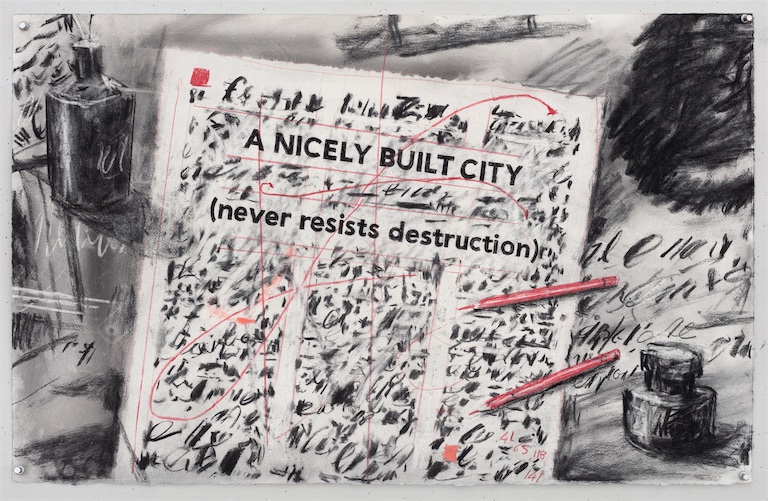
William Kentridge, A Nicely Built City (Never Resists Destruction), 2026, Charcoal, pastel and coloured pencil on paper, Height varies, 41-51.5 x 80 cm, Courtesy the artist and Goodman Gallery
“It is an honour to present the global premier of William Kentridge’s new film, A Nicely Built City (Never Resists Destruction), at our London premises,” says Liza Essers, owner of Goodman Gallery. “Inaugurated in 1989 with the animated film Johannesburg, 2nd Greatest City After Paris, this acclaimed film series was first given a platform by Goodman Gallery in 1992 in Johannesburg. The films later formed a major component of William Kentridge’s first institutional survey in Britain at the Serpentine Gallery in 1999. This exhibition marks the first time a new Drawings for Projection film has premiered in the United Kingdom. On the occasion of the gallery’s sixtieth anniversary, Goodman Gallery is delighted to premiere the next chapter of this evolving body of work, underscoring our longstanding relationship with the artist.”
Repurposed and qualified from the title of the 1995 etching with the introduction of parentheses, A Nicely Built City (Never Resists Destruction) immerses the viewer in contemporary Johannesburg, a post-colonial city racked by infrastructural and environmental challenges as it adapts from its foundational gold-mining economy.
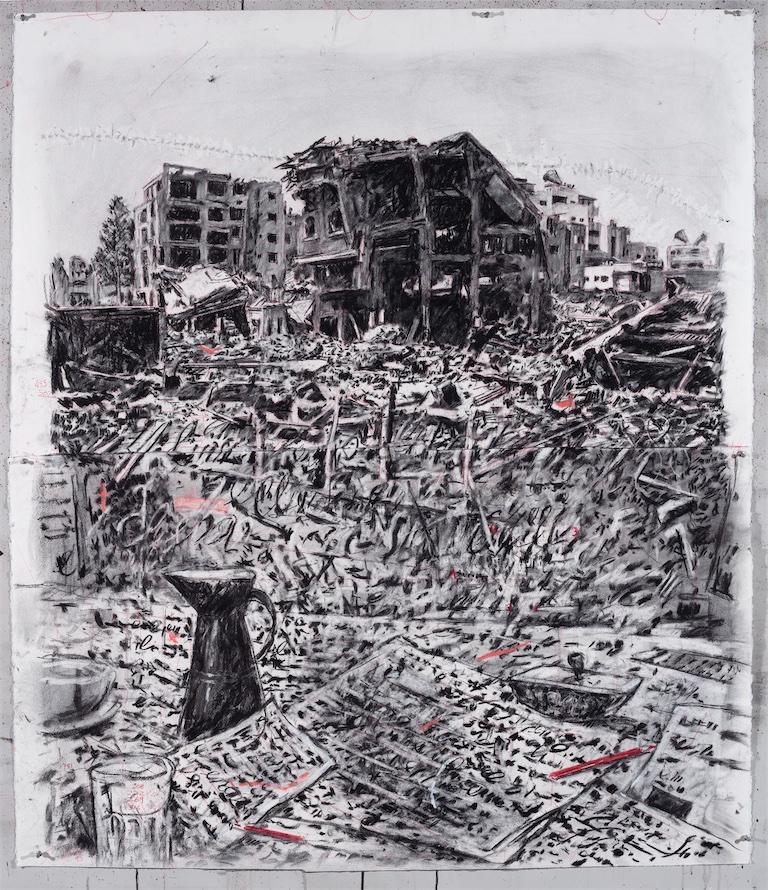
William Kentridge, Drawing for A Nicely Built City (Aftermath), 2026, Charcoal, pastel and coloured pencil on paper, 141.5 -140 x 120.5 cm, Courtesy the artist and Goodman Gallery
Merging social and personal biography, this elegiac film summons events familiar to the city’s dogged residents, including trees stricken by the fungus of a non-indigenous beetle and a fictional reimagining of the July 2023 methane gas explosion that destroyed parts of Bree Street in central Johannesburg. The action of the film moves between the turbulent commons of Johannesburg’s city streets and the sedate modernist home of industrialist Soho Eckstein, a central protagonist in Kentridge’s evolving cycle of films.
A transforming cat is the protagonist that changes the story, allowing us to journey through shifting associations. “Is it a witch? Is it the devil? Is it an associate of the devil?,” says Kentridge. “Is it simply a family pet? Is it the imagination of Soho?”
The scholar Jane Taylor, a regular interlocutor and collaborator with Kentridge, notably on the theatrical production Ubu and the Truth Commission (1997), saw in the artist’s black cat a possible allusion to physicist Erwin Schrödinger’s cat. Much in the way Schrödinger used the cat to make an argument about entanglements, ‘A Nicely Built City’ proposes overlaps and entanglements across Kentridge’s various projects and the formats in which they are expressed.
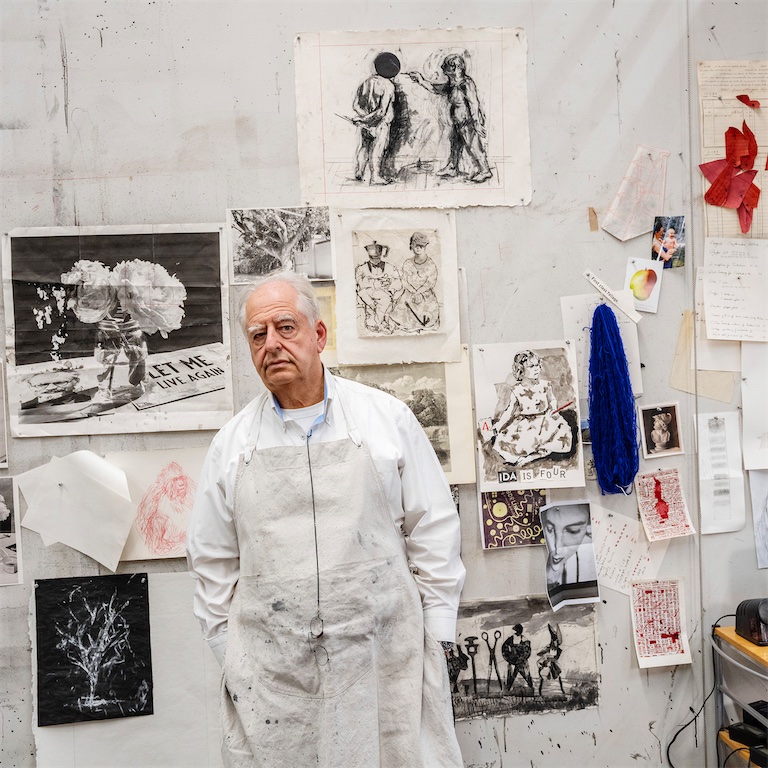
William Kentridge, Courtesy the artist and Goodman Gallery. Photo: Jabulani Dhlamini
“In 1989, when I made Johannesburg, 2nd Greatest City After Paris, Soho Eckstein was a much older man,” says Kentridge of his fictional protagonist and proxy for avarice. “I was the age of Felix Teitelbaum, the other protagonist in the early films. In the 37 years that have followed, Soho hasn’t really aged, but I have. What used to be a very external, antagonistic character has, over the years, by default, become closer to me. The challenge for me as an artist has always been to find a connection between my life and the life of Johannesburg, and the world of Soho in the films.”
Installed at the entrance to the exhibition is Fat Cat (2025), a new bronze edition depicting a flat-faced black cat with a huge belly. Derived from an earlier, paperweight-sized edition, the bronze features an inscription, lightly etched in cursive across its body, linking Kentridge’s sculptural cat to Behemoth, the vodka-loving black cat appearing in Mikhail Bulgakov’s novel The Master and Margarita (written 1928-40, published in 1966-67). Drawings of cats and felines recur throughout the exhibition, along with depictions of trees – juxtaposed with Fat Cat at the entrance is a large, multi-sheet ink drawing of a tree.
A recurring motif in Kentridge’s mature output, meriting a spotlight section in his 2022 survey exhibition at the Royal Academy in London, trees not only gesture to the leafy landscape of Houghton, where Kentridge lives and maintains a studio, but also connect to the figure of Eurydice. In Monteverdi’s opera L’Orfeo, Orpheus journeys to Hades to retrieve his dead bride Eurydice, an oak tree nymph or dryad. Arboreal motifs also recur in A Nicely Built City (Never Resists Destruction), a film in which ruined buildings – based on contemporary images of Caracas, Gaza, Johannesburg, Tehran and Tel Aviv – transform into trees.
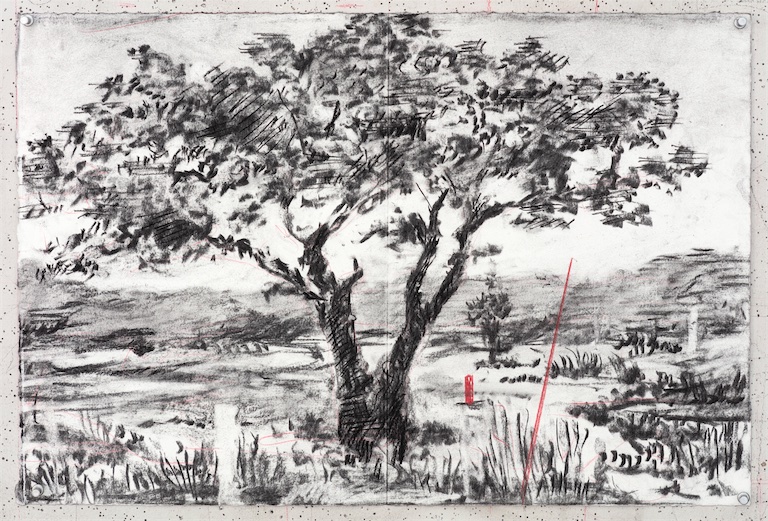
William Kentridge, Drawing for L’Orfeo (Diverging Tree), 2025, Charcoal and coloured pencil on paper, 40 x 59.5 cm, Courtesy the artist and Goodman Gallery
The exhibition also gathers a number of works developed in relation to Kentridge’s production of L’Orfeo at the 2026 Glyndebourne Festival. Orpheus, Eurydice, Hermes (2026) is a new Pepper’s Ghost film installation integrating workshop footage for L’Orfeo filmed in Johannesburg with works on paper, sculpture and found paper ephemera. Part of a lineage of mechanised theatres, like Black Box/Chambre Noire (2005), the format of this work evolved out of theatre projects at The Centre for the Less Good Idea, an interdisciplinary incubator established in 2016 by the artist.
Orpheus, Eurydice, Hermes is the third example of this nineteenth-century optical illusion utilising a pane of glass and strategic lighting to make objects appear or disappear on stage. It will be exhibited at the National Archaeological Museum, Athens, to coincide with L’Orfeo at the Greek National Opera, in November 2026. The title of the installation derives from Rainer Maria Rilke’s 1904 poem ‘Orpheus. Eurydice. Hermes’, fragments of which Kentridge projected as backdrop to his production of L’Orfeo.
The presentation also includes a suite of six figural sculptures produced in collaboration with renowned Belgian costume designer Greta Goiris. Made from wood, fabric and found materials, the sculptures are based on studio models for costumes worn by actors portraying the spirits of the underworld in L’Orfeo. There is also a suite of composite ink drawings inventorying classical forms and figures appearing in the opera and linked to Kentridge’s bountiful visual language.
William Kentridge: ‘A Nicely Built City’, 24 September – 07 November 2026 at Goodman Gallery, 26 Cork Street, Mayfair, London W1.